
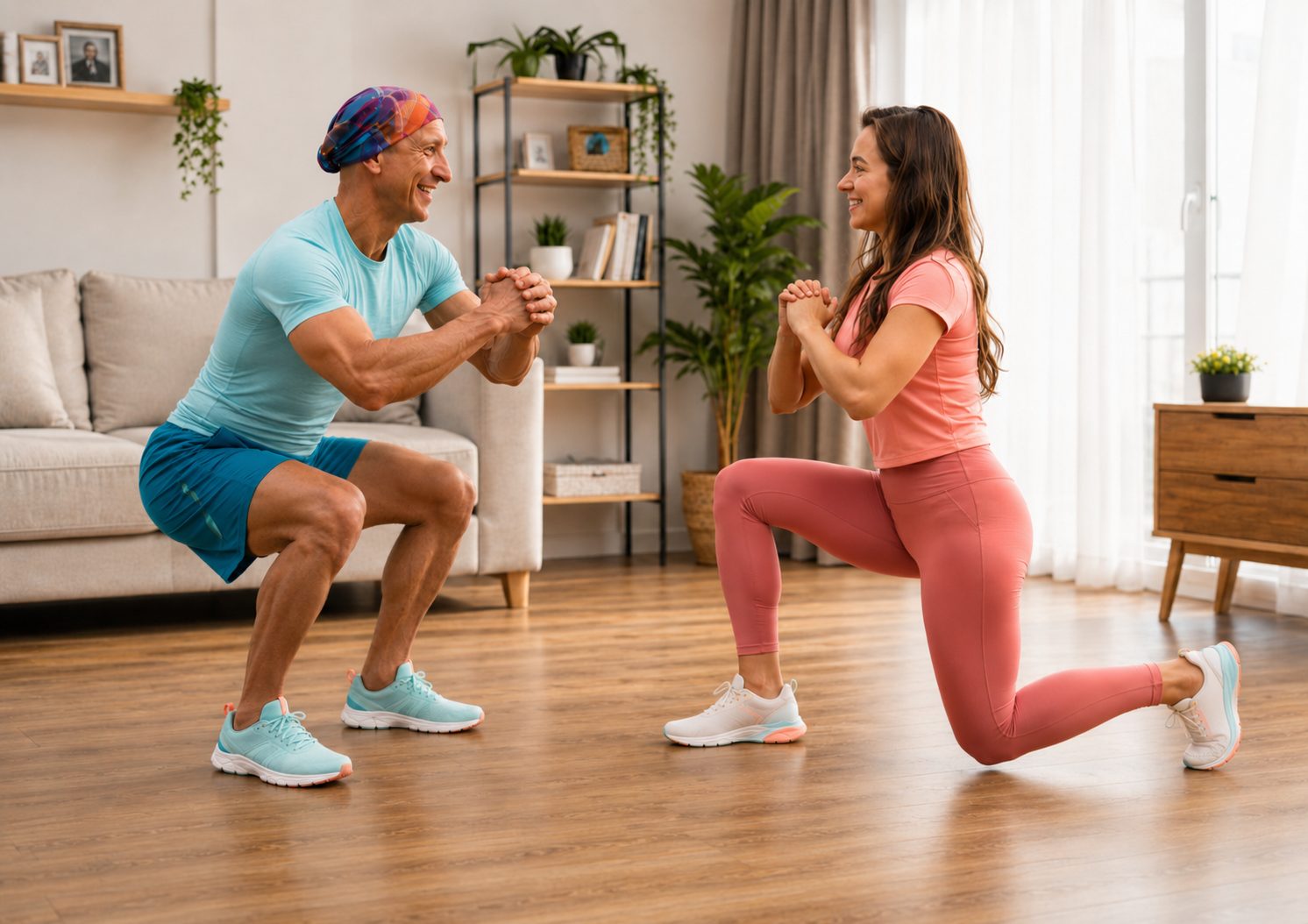
⏱ 10 min read
Most people do not struggle with exercise because they are lazy. They struggle because the plan asks too much from real life.
Drive to the gym. Find an open machine. Wait for equipment. Follow a complicated routine. Then try to repeat the whole process several times next week.
There is another way.
This no-equipment workout at home removes many of those barriers. You need some floor space, comfortable clothes, and about 40 minutes. That is enough for a structured session that trains your legs, upper body, core, and cardiovascular fitness.
The goal is not to make exercise complicated.
The goal is to make it repeatable.
Can You Get a Good Workout at Home With No Equipment?
Yes. A well-designed bodyweight workout can improve strength, fitness, movement quality, and physical function without gym equipment.
Your muscles respond to resistance and effort. That resistance does not always need to come from dumbbells or machines.
Your own body can provide it.
Squats train your legs and hips. Push-ups work your chest, shoulders, arms, and core. Lunges challenge your legs and balance. Planks and controlled core movements teach your body to stay stable while other muscles work.
Bodyweight training is also easy to adjust.
A beginner can use a shorter range of motion, slower pace, easier variation, or more rest. A more experienced person can use deeper movements, slower repetitions, longer working periods, or more demanding variations.
The room stays the same.
The challenge changes with you.
Why Simple Home Workouts Are Easier to Repeat
The most useful workout is not necessarily the hardest one.
It is the one you can keep doing.
Training at home removes several common barriers. There is no commute, no gym timetable, and no waiting for equipment. You can train before work, after work, or whenever your day gives you a useful 40-minute window.
That matters because fitness develops through repeated training over time.
One workout can make you feel accomplished.
A routine can change what your body is capable of doing.
Start With the Level You Can Control
Do not turn your first session into a test.
You should finish knowing that you worked, but also feeling capable of coming back and training again.
If you are new to exercise, move slowly and take extra rest when needed. If you already train regularly, increase the pace or choose harder variations while keeping good form.
Quality comes before speed.
A controlled squat is more useful than several rushed repetitions. A clean push-up is more useful than forcing repetitions after your body position has collapsed.
Workout at Home No Equipment: 40-Minute Full-Body Plan
This BHL workout uses a simple 40-minute structure:
5-minute warm-up + 20 minutes strength + 8 minutes conditioning + 4 minutes core + 3-minute cool-down.
For the timed sections, work for 40 seconds and use 20 seconds to recover and prepare for the next exercise.
If you are a beginner, reduce your pace or take additional rest when needed. There is no reward for sacrificing form just to finish the timer.
Warm-Up — 5 Minutes
Spend about one minute on each movement.
March in Place
Begin at an easy pace. Gradually lift your knees higher and allow your arms to move naturally.
Arm Circles and Reaches
Move your shoulders through a comfortable range. Keep the movement controlled rather than forcing a deeper stretch.
Bodyweight Good Mornings
Stand tall with soft knees. Push your hips backward while keeping your spine neutral, then return to standing.
Alternating Reverse Lunges
Step one foot backward and lower under control. Use a shorter step and smaller range of motion if balance is difficult.
Easy Bodyweight Squats
Sit your hips back and down while keeping your feet stable. Stand tall at the top.
At the end of five minutes, you should feel warmer and ready to train — not tired.
Strength Circuit One — 10 Minutes
Complete the five exercises in order using 40 seconds of work and 20 seconds of recovery.
Then repeat the circuit once.
Bodyweight Squat
Stand with your feet around shoulder-width apart. Move your hips back and bend your knees while keeping your feet stable. Push through the floor and return to standing.
Beginner: Use a comfortable, shallower range of motion.
More challenge: Lower yourself slowly for about three seconds before standing.
Push-Up
Place your hands slightly wider than shoulder width. Keep your body controlled as you lower your chest toward the floor, then press back up.
Beginner: Perform the movement from your knees or use an elevated stable surface.
More challenge: Slow the lowering phase and briefly pause near the bottom.
Alternating Reverse Lunge
Step one foot backward and lower under control. Push through the front foot to return to standing, then change sides.
Keep the front knee moving in roughly the same direction as your toes.
Beginner: Reduce the depth.
More challenge: Add a controlled knee drive when returning to standing.
Glute Bridge
Lie on your back with your knees bent and your feet on the floor.
Press through your feet and lift your hips under control. Pause briefly near the top, then lower.
Avoid forcing your lower back into an exaggerated arch.
Bird Dog
Begin on your hands and knees. Extend one arm and the opposite leg while trying to keep your trunk still.
Return slowly and change sides.
Think about control, not height.
Strength Circuit Two — 10 Minutes
Complete these five movements using the same 40-second work and 20-second recovery pattern.
Repeat the circuit once.
Alternating Lateral Lunge
Step to one side, move your hips backward, and bend the stepping leg while the opposite leg stays more extended.
Push back to the starting position and change sides.
Use only the range of motion you can control.
Plank Shoulder Tap
Begin in a high plank. Lift one hand and lightly touch the opposite shoulder.
Change sides while trying to prevent your hips from rotating.
Beginner: Perform the exercise from your knees.
Squat to Calf Raise
Perform a controlled bodyweight squat. As you return to standing, rise onto the balls of your feet.
Lower your heels before beginning the next repetition.
Slow Mountain Climber
Start in a high plank.
Bring one knee toward your chest, return it, then change sides. Keep your shoulders stable and your body controlled.
Speed is optional.
Control is not.
Hip Hinge
Stand tall with your knees slightly bent. Push your hips backward while keeping your spine neutral.
Stop when you feel tension through the back of your legs, then bring your hips forward and return to standing.
Learning to move through the hips is useful far beyond this workout.
Conditioning — 8 Minutes
Complete these four movements for 40 seconds each with 20 seconds of recovery.
Repeat the sequence twice:
- Step jacks
- Squat and reach
- Controlled mountain climbers
- Side-to-side skater steps
Increase the pace only if your movement remains controlled.
You do not need to jump to make the workout effective. Low-impact variations are useful for beginners, people returning after a break, or anyone who prefers less impact.
The goal is to increase your effort without losing control.
Core — 4 Minutes
Finish with four exercises:
- Dead bug
- Forearm plank
- Alternating heel taps
- Glute bridge hold
Use 40 seconds of work and 20 seconds of recovery for each movement.
During core exercises, do not think only about your abdominal muscles.
Think about controlling your trunk and preventing unnecessary movement.
Your core works like the center of a bridge. When the middle is stable, the rest of the structure can work more efficiently.
Cool-Down — 3 Minutes
Do not finish the final exercise and immediately rush into the next part of your day.
Walk gently around the room and allow your breathing to settle.
Use comfortable, easy stretches for areas such as your hips, thighs, chest, and shoulders.
Do not force a stretch.
The cool-down simply gives your body a gradual transition from training back to normal activity.
How Often Should You Do This Workout?
For many beginners, two or three full-body workouts per week can be a practical starting point, with recovery between harder sessions.
More is not automatically better.
Training provides the challenge. Recovery gives your body time to adapt.
As your fitness improves, you can progress by improving movement quality, increasing your range of motion, using more difficult variations, or adding other types of activity during the week.
You do not need to replace your entire workout every seven days.
Progress can come from doing familiar movements better.
How Do You Make a No-Equipment Workout Harder?
Make a bodyweight workout harder by changing one training variable at a time.
You can:
- Move more slowly.
- Pause in a difficult position.
- Increase your controlled range of motion.
- Choose a harder exercise variation.
- Add repetitions when appropriate.
- Reduce unnecessary rest.
- Improve balance and movement control.
When an exercise becomes easier, that is not a problem.
It is evidence that your body has adapted.
Progress should feel like turning a dial, not flipping a switch.
Common Home Workout Mistakes
Starting Too Hard
A session that leaves you unable to move comfortably for several days is not proof that it was a better workout.
Start at a level you can recover from and gradually build from there.
Chasing Speed
Fast repetitions can hide poor movement quality.
Use a pace that allows you to control the exercise.
Changing the Workout Constantly
Your body needs repeated exposure to movements before you can judge progress.
Variety has a place, but constant change can make improvement difficult to measure.
Waiting for Motivation
Motivation changes from day to day.
A simple routine reduces the number of decisions you need to make.
Building self-discipline can make that routine easier to maintain over time.
You know where to train.
You know what to do.
You begin.
Is a 40-Minute Home Workout Enough?
Yes. A focused 40-minute home workout can be a meaningful part of a healthy weekly exercise routine.
U.S. physical activity guidelines recommend that adults accumulate 150 to 300 minutes of moderate-intensity aerobic activity each week and perform muscle-strengthening activity on at least two days per week.
That does not mean every workout has to contain everything.
Your weekly activity pattern matters more than trying to make one session perfect.
This workout combines bodyweight resistance training with conditioning, making it a practical option when time, gym access, or equipment is limited.
Frequently Asked Questions
Can Beginners Do This Workout?
Yes. Beginners can use easier exercise variations, a smaller range of motion, slower movement, and additional recovery. Good technique should come before speed or intensity.
Can Bodyweight Exercises Build Strength?
Yes. Bodyweight resistance exercises can improve strength and physical function when the movements are challenging enough for your current ability and gradually progress over time. Current resistance-training guidance also recognizes bodyweight and home-based training as effective options.
Do I Need Shoes for a Home Workout?
Not always. It depends on the exercise, flooring, and your personal comfort. Whatever you choose, train on a stable, non-slip surface that allows you to move safely.
Do I Need to Jump?
No. Jumping is not required. Step jacks, controlled mountain climbers, and side-to-side steps can increase effort without using high-impact movements.
Should I Do This Workout Every Day?
You do not need to train the same muscles hard every day. Recovery is part of training. A balanced week can include full-body workouts, walking or other aerobic activity, lighter movement, and rest.
What If I Cannot Finish All 40 Minutes?
Complete what you can with good form and build gradually.
Twenty controlled minutes are more useful than forcing forty poor ones.
Consistency matters more than completing a perfect workout on day one.
Safety First
Exercise should challenge you, but sharp or unusual pain is not a training goal.
Stop exercising if you experience chest pain, faintness, severe dizziness, unusual shortness of breath, or sharp or unexpected pain.
If you are pregnant or postpartum, returning after an injury or surgery, or have a diagnosed medical condition that may affect exercise, speak with an appropriate healthcare professional before beginning or significantly changing your exercise routine.
This article provides general fitness information and is not a substitute for individualized medical, physiotherapy, or rehabilitation advice.
A Simple Plan Is Easier to Start Again
You do not need a perfect room.
You do not need expensive equipment.
And you do not need to feel motivated before every workout.
You need a plan simple enough to begin and useful enough to repeat.
Start at your current level. Learn the movements. Improve them gradually.
Then come back and do it again.
Want a structured next step? Explore the Better Healthy Life Full Body Workout Program and see how a complete BHL training plan can fit into your week.
